
King County Traffic Court Records
Which court holds your traffic record? It depends on who issued the citation. King County splits its traffic files by court. King County District Court, known as KCDC, hears county infractions and other limited-jurisdiction matters. Seattle, Kent, Renton, and Federal Way each run a municipal court for their own city cases. Bellevue's municipal traffic work goes through KCDC instead. So the notice itself controls: read the issuing agency, the place, the ticket type, and the court printed on it before searching any docket.
A traffic docket can hold a lot. Expect the infraction notice or criminal traffic charge, the person's response, hearing events, written statements, an order or judgment, payment or deferral activity, and the final disposition. The clerk of the issuing court keeps that case file. Parking and photo-enforcement matters may follow a different city route, so the face of the citation decides.
King County Traffic Response Clock
KCDC sets two response deadlines. An in-person ticket from an officer is due in 30 days. One that arrives by mail gets 33 days. The back of the ticket lists four paths. You can pay, request a payment plan, seek a mitigation hearing, or request a contested hearing. Check one choice and sign. Add current contact details, and mail it to the courthouse on the citation or file it at any KCDC location.
That response is a real court filing, not just a payment preference. It shapes what the King County traffic docket shows next. Mitigation accepts that the infraction happened and asks the judge to weigh the facts. Contesting challenges whether it happened at all. In a contested case, the government must prove the infraction. The standard is a preponderance of the evidence. The official response source shows the court's current instructions.
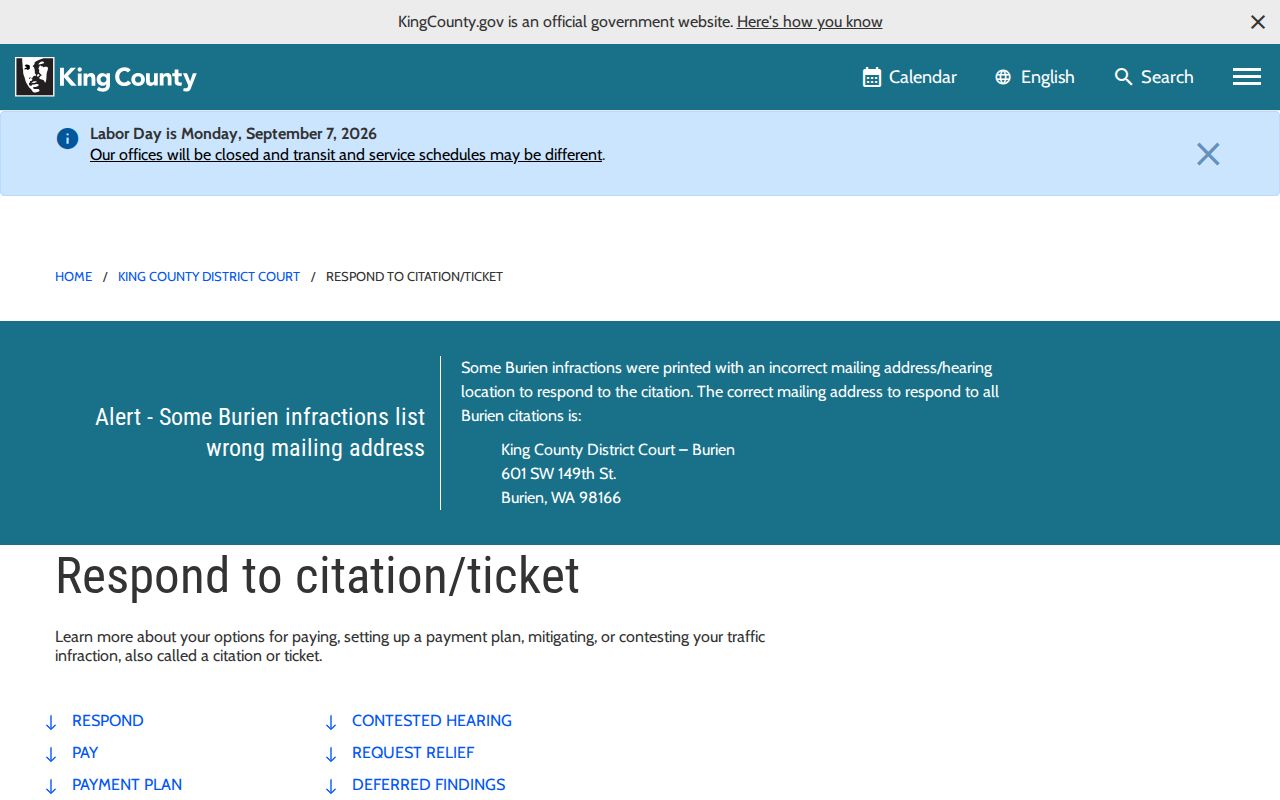
Check the ticket's court and deadline before any portal.
Looking Up a Traffic Ticket
Start every lookup with the case number and the issuing court. KCDC case access requires a free portal account, though paying may not. Seattle runs its own ticket portal. AOC can find many district and municipal cases. But its Find My Court Date tool leaves out Seattle Municipal Court.
- Read the court name and exact case or citation number from the ticket.
- For KCDC, sign in, choose Case Search, select Criminal/Infraction, and enter the number without surrounding spaces.
- Without a number, search by first and last name, filing period, and optional date of birth.
- For Seattle, choose Citation Search or Party Search in the municipal portal.
- Use AOC as a cross-court index, then confirm the result with the court of record.
- Call or visit the clerk when a new ticket has not posted or a result conflicts with the paper notice.
| Portal field | Requirement or choice |
|---|---|
| KCDC Case Type | Select Criminal/Infraction for a name search |
| KCDC Case Number | Enter the exact number with no spaces around it |
| KCDC name search | First and last name, filing date; birth date is optional |
| Seattle Search Type | Citation Search or Party Search |
| Seattle Cited Party Name | Use the plate number for a vehicle ticket lookup |
| AOC Find My Court Date | Court name, last name, and first initial; Seattle is excluded |
King County Traffic WebHearing Choices
An eligible KCDC case shows a WebHearing button on the Summary screen. The required Response Choice list offers Contested Statement, Deferred Finding, or Mitigation Statement. The online statement route has limits. The violation must fall within the last 47 days. No hearing can already have occurred. No prior WebHearing statement may have been filed, and the case cannot be closed.
After you submit, a red error or yellow warning must be fixed. KCDC says to upload the documents again even when old filenames remain visible. A written Defendant's Statement for a contested or mitigation matter must reach the court at least seven days before the hearing. In-person and Zoom attendance may also be available. The KCDC ticket portal instructions page lays out the current workflow.
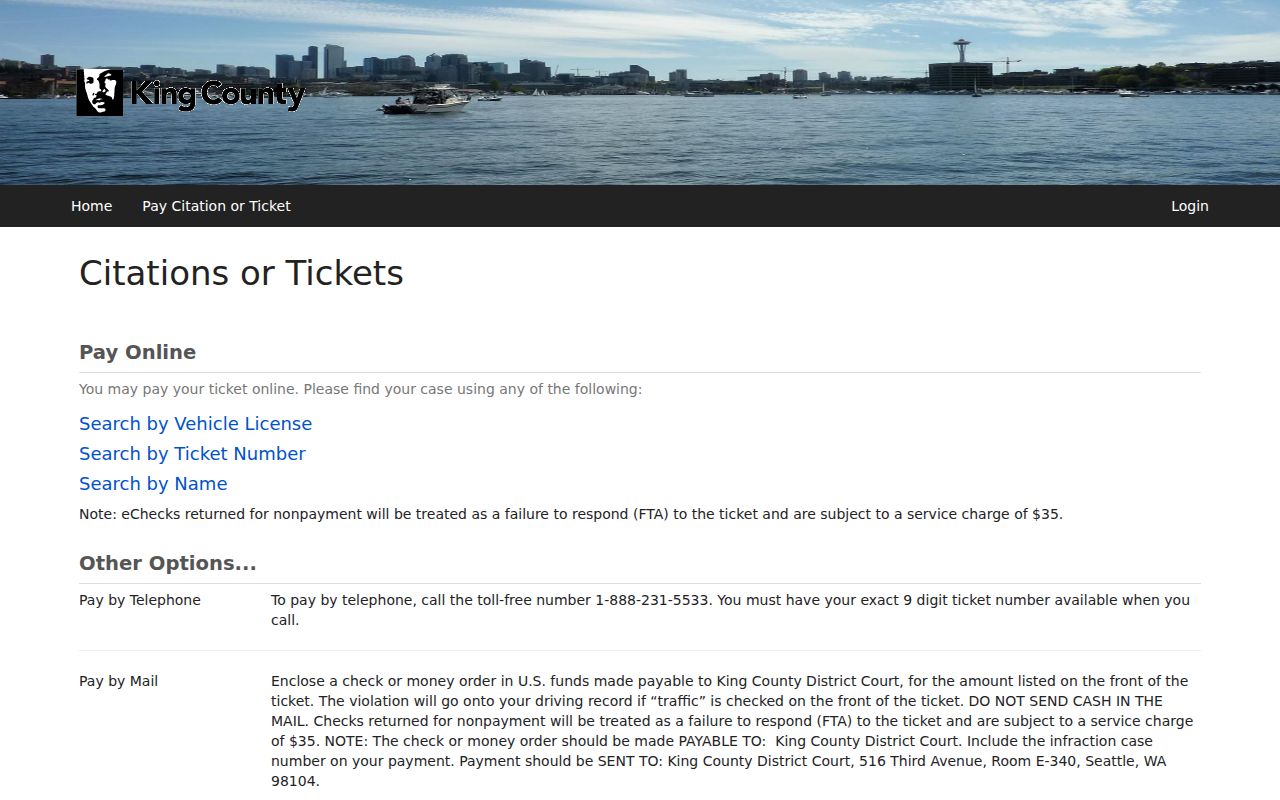
The portal view ties your response to the King County court case already on file. It does not create a separate driver record.
How to Find Your Traffic Court Date
A hearing date can surface in several places. Check the ticket first. The KCDC Summary or Events tab, the municipal portal, and the statewide date tool may all list it. The Events view is the best KCDC source. It shows the date, time, event type, result, judicial officer, location, and minute record. A courtroom-availability calendar is not a confirmed setting.
| Case number | Use the exact local number, shown here only as KCDC citation number; formats differ by court. |
|---|---|
| Court | KCDC or the named Seattle, Kent, Renton, or Federal Way municipal court. |
| Date and time | The scheduled hearing shown in Events or the court's own case record. |
| Event type | Mitigation, contested, arraignment, or another court-listed setting. |
| Location | The assigned courthouse, courtroom, or approved remote session. |
| Result | A status such as held, reset, or another court-entered outcome. |
Notices and online entries sometimes differ. Call the court shown on the ticket when they do. KCDC's central number is 206-205-9200. For city courts, dial Seattle Municipal Court at 206-684-5600, Kent at 253-856-5730, Renton at 425-430-6550, or Federal Way at 253-835-3000.
King County Municipal Traffic Ticket Routes
Seattle's municipal portal handles citation and party searches itself. Its Find My Ticket Information instructions are the right local route. AOC Find My Court Date skips Seattle Municipal Court. Kent, Renton, and Federal Way each publish their own paths for dates, payments, and records. Bellevue is the odd one out, with municipal-court services flowing through KCDC.
These routes are not interchangeable. A city citation fed into a county portal may return no match even though the case exists. Start with the court printed on the ticket. No useful online result from the issuing city? Call that court's clerk. File in person at the city court or, for KCDC matters, at any District Court courthouse. For mail, use the court and address printed on the ticket.
Pay or Contest a Ticket
Paying, setting up a plan, mitigating, and contesting are four different court responses. Payment resolves the amount through the listed channel. Mitigation admits the infraction. It asks the judge to weigh the circumstances, though. That may bring a reduced penalty or time payments. Contesting disputes the infraction outright and leads to an evidentiary hearing. Under the court's process, you may request a witness or officer subpoena.
| Pay or plan | Mitigate | Contest |
|---|---|---|
| Accept the amount or seek scheduled payments | Admit the infraction and explain circumstances | Challenge whether the infraction occurred |
| Use the court's payment channel | Request a hearing or eligible written statement | Request a contested hearing or eligible statement |
| Meet the response deadline | Judge may reduce the amount or allow time | Government bears the preponderance burden |
Failure to respond or appear: KCDC may deem the infraction committed, add a $52 penalty, send unpaid debt to collections, and notify DOL, which may suspend driving privilege.
King County Traffic Deferred Findings
A deferral puts a King County traffic ticket on hold. The driver works through conditions the court sets. KCDC allows a judge to defer a case for up to 12 months. Eligibility is tight. The court grants one moving violation deferral every seven years. It also grants one non-moving deferral every seven years. A commercial driver license holder is not eligible. A $150 monitoring fee may also apply.
Everything then rides on compliance. Meet the terms and the court enters the result it set. Miss them and the judge may revoke the deferral. The court can impose the original fine plus costs and report the matter to DOL. The docket and the signed order, not a general summary, tell what happened in the individual case.
Traffic Court Record vs Driving Record
Two different offices keep two different files. The clerk of court holds the King County court record for the citation itself. Washington's Department of Licensing keeps the state driver file. A docket search at the courthouse answers whether a case was filed, what response was chosen, what hearing occurred, and what judgment or order was entered. DOL holds license status and reportable events.
| Point | Court traffic record | DOL driving record |
|---|---|---|
| Custodian | KCDC or the municipal court clerk | Washington Department of Licensing |
| Core contents | Citation, response, hearing, order, payment, disposition | License status and reportable traffic events |
| Access route | Court portal, clerk, counter, mail, or records request | DOL's own record channel |
| Best verification | Issuing court and signed court order | DOL for the state-maintained driver file |
Compliance with a deferral can hit each file differently. Parking and photo-enforced tickets may not follow moving-infraction rules. Check the case with the court and the driver file with DOL.
King County Traffic Payment Program
Payment help exists. The Unified Payment Program covers KCDC and participating municipal courts. Those include Bellevue, Federal Way, Kent, Renton, and Seattle. It bundles eligible outstanding tickets once bench warrants are resolved. Applying requires a nonrefundable application fee and at least a $25 monthly payment. A monthly fee and an approved debit, credit, or checking method are also required.
The payment agency then works with participating courts and DOL to lift a license hold after the first installment. This is a payment path, not a King County traffic ticket search. Each citation still belongs to its issuing court. Its docket stays with that clerk.
The official program page documents its countywide reach.
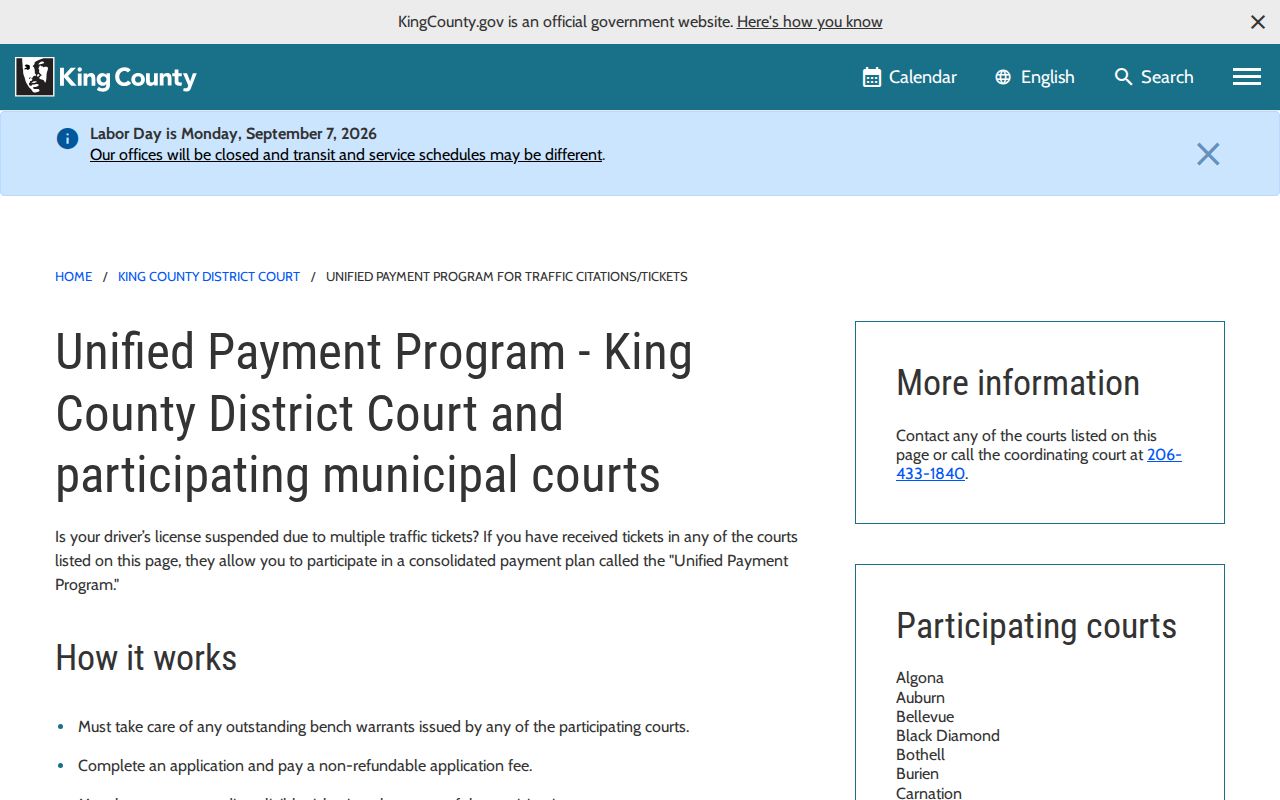
The payment plan is not the court record.
Copies and Fees
A traffic docket, a plain copy, and a certified copy are three different products. Request the docket or an order from the issuing court's clerk. KCDC provides public terminals and accepts a Request for Court Records by email. Municipal courts use their own forms. AOC is only an index, though. It cannot certify a King County court document.
| King County record item | Published fee | Route |
|---|---|---|
| KCDC docket or order copy | No full public image-fee table published | Ask KCDC records staff or use a public terminal |
| Superior non-certified copy, if applicable | $0.50 per page | Superior Court Clerk |
| Superior certified copy, if applicable | $5 first page; $1 each added page | Superior Court Clerk |
| Renton paper record | $0.15 per page | Renton Municipal Court request |
| Renton research after first hour | $30 per hour | Renton Municipal Court request |
Most traffic infractions live in District or municipal court. Superior Court fees do not apply to those files. Ask the actual clerk for the current charge, and say whether the copy must be plain or certified.
King County Traffic Ticket Access Fallbacks
The internet is not the only door. KCDC offers several routes. Use the portal, call the central clerk, visit a public terminal, file a response at any KCDC courthouse, or mail the signed response to the location on the ticket. Copies of court records come through the official form. Seattle, Kent, Renton, and Federal Way each run a local clerk route too.
The statewide AOC search can identify many district and municipal cases. It may lag, though, and it can be incomplete. It never replaces the full local file. When a hearing date is at risk, ask the court of record directly, because that office is the final confirmation source. The related King County court dates page explains calendar checks, while the ticket itself remains the key routing document.
Keep proof of any mailed or online response. Confirm the court docket shows it before assuming the filing was accepted.