
Searching King County Criminal Dockets
Every King County criminal docket search starts with the court named on the paperwork. Felonies belong to King County Superior Court. The Department of Judicial Administration maintains the docket there. Misdemeanors and gross misdemeanors take a different route. Preliminary felony matters, traffic crimes, and infractions often land in King County District Court as well. A municipal case stays with the city court that filed it. Seattle runs its own portal, and the statewide date tool leaves Seattle Municipal Court out. If you have the exact case number, use it. A name search alone is fuzzier. It may need a filing date or a case-type filter to narrow things down.
- Read the notice for the court name, case number, and location.
- For a Superior felony, sign in to KC Script and open the case index.
- For District Court, sign in to the KCDC portal, select Criminal/Infraction, and search.
- For a city case, use its municipal portal or clerk; use the AOC index as a cross-court check.
- Confirm live hearings with the court and request certified copies from its clerk.
King County Felony and Misdemeanor Split
Court level drives any King County criminal docket search. Felony trials happen in Superior Court. That court keeps judgments, sentence records, minute entries, orders, exhibits, and related audio. District Court takes the county misdemeanors and gross misdemeanors within its authority. Traffic crimes and infractions land there too. City courts handle ordinance violations and many misdemeanors tied to the city.
| Court | Criminal docket | Primary route |
|---|---|---|
| Superior Court | Felonies and general-jurisdiction matters | KC Script and criminal calendars |
| District Court | Misdemeanors, traffic crimes, infractions | KCDC Case Access Portal |
| Municipal Court | City ordinance, misdemeanor, and traffic matters | City portal or clerk |
A preliminary felony entry in District Court does not bind the prosecution to that court. Check for a later Superior Court filing before treating that first limited-jurisdiction result as the final docket.
Inside a King County Criminal Docket
Think of the docket as a chronology rather than a verdict. KCDC labels its main views Summary, Charges, Documents, Events, Other Cases, and Register of Actions. The public guide breaks out event details like date, time, event type, result, official, location, and a linked Minute Record. Through KC Script you may reach the case index, calendar, docket, orders, judgments, minute entries, and document requests. Image access and index access are two different things.
| Case number | The court identifier and best search key; formats differ by court. |
|---|---|
| Caption and status | The prosecuting party, defendant, filing date, court, and current status. |
| Charges | Counts, offense labels, statute or class when displayed, and amendments. |
| Events | Arraignment, bond, motions, omnibus, plea, trial, sentencing, result, official, and location. |
| Disposition | Conviction, acquittal, dismissal, deferred result, or another entered outcome. |
| Documents | Pleadings, orders, minute entries, judgment, and sentence indexes; images may be limited. |
A scheduled event is not proof it occurred. Read its result, then locate the signed order or judgment.
KCDC Criminal Events in King County
District Court users should keep Summary and Events apart. Summary gives the caption, filing date, and status. The future-hearing panel points to the next scheduled event, while the full Events tab holds past and future entries. The official example lists “Arraignment (Video),” “Pre-Trial Conference,” and the result “Held.” A held event is past action, not a new date. The District Court criminal-case source shows the court's route.
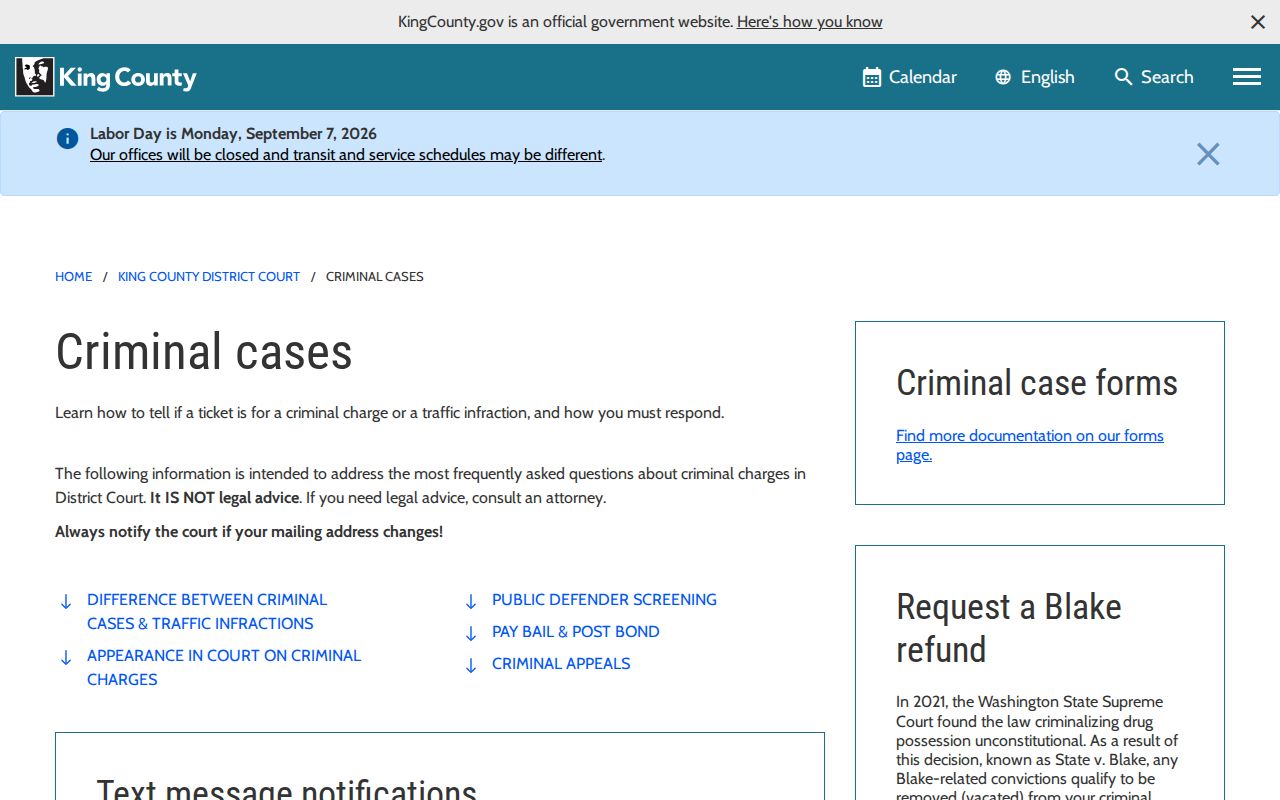
That page helps separate the District Court path from the Superior Court felony route. If a search comes up empty, change the court or filing window first. Then call the court of record before assuming anything.
How a Criminal Case Moves
A King County criminal docket may open with a complaint, citation, probable-cause filing, information, or indictment. Early events often cover appearance, counsel, arraignment, plea, release, or bond. Pretrial entries may record discovery, motions, competency review, plea talks, and trial readiness. A calendar label only states what is set. It does not prove the event occurred.
Docket flow: Filing › Arraignment › Pretrial › Plea or Trial › Disposition › Sentencing
Read every event with its result. “Held,” “Continued,” “Vacated,” and “Reset” each change what a line means. For the final outcome, find the signed judgment, sentence, dismissal, or other order. A plea-calendar or trial-calendar entry alone is not a disposition.
King County Criminal Calendar Labels
Superior Court posts separate Seattle and Kent criminal calendars. They go up by 3 p.m. for the next court day. Seattle lists Bond, Competency, Criminal Motions, Expedited Motions, Omnibus, Plea, Trial, and Friday Sentencing calendars. Kent carries the same core groups. The cited inventory shows no separate Competency calendar there, though. The official criminal calendar page is the source for those schedules.
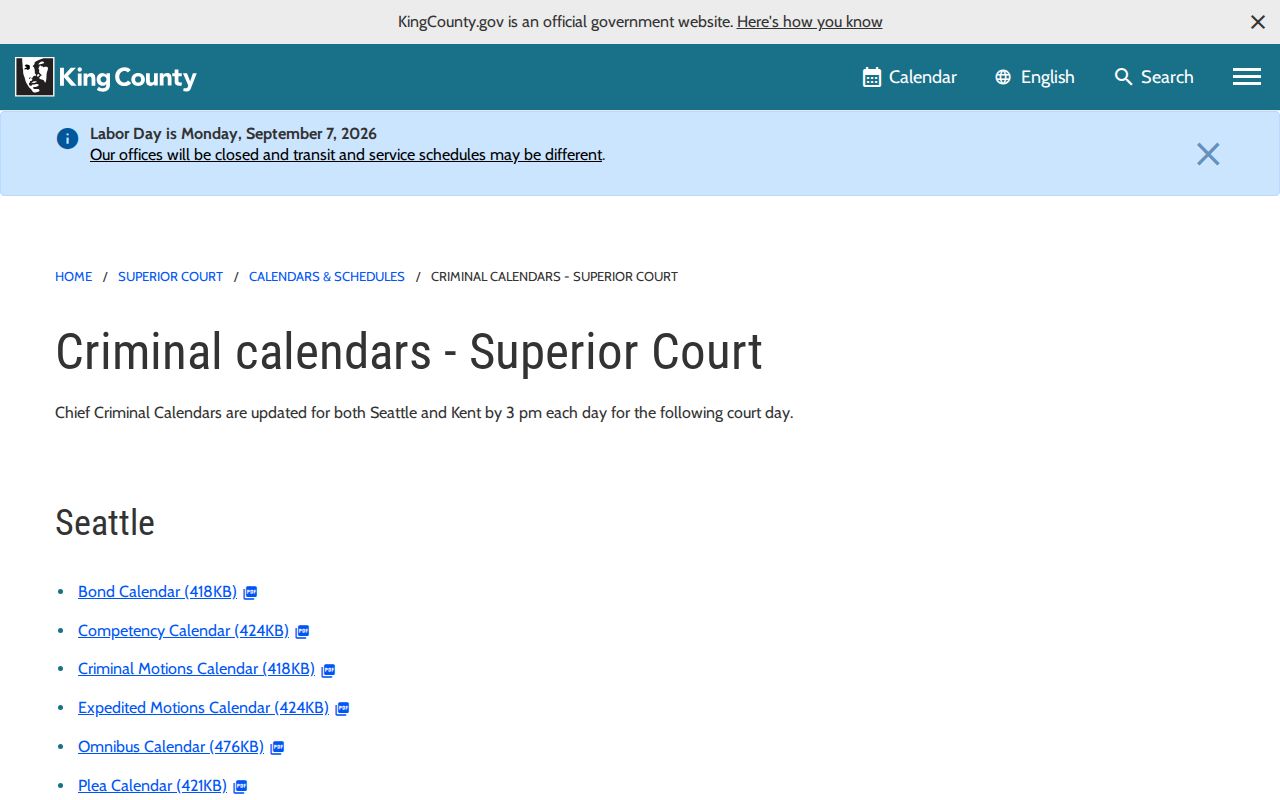
The posted list gives day-of-court context, but the active case docket and direct notice control. A calendar can change after publication.
Courts That Hold Criminal Dockets
Different offices hold different files. King County Superior Court records sit with the Superior Court Clerk/DJA. KCDC clerks keep District Court files. Each municipal clerk, meanwhile, keeps its own city file. Seattle, Kent, Renton, and Federal Way run separate municipal systems. Bellevue municipal court services run through King County District Court instead. So the court name is a required search fact, not an optional filter. When online access fails, try a public terminal at a Superior Clerk or KCDC location. You can also phone the court of record: Superior Clerk at 206-296-9300, KCDC at 206-205-9200, Seattle at 206-684-5600, Kent at 253-856-5730, Renton at 425-430-6550, or Federal Way at 253-835-3000. KCDC requests may go to kcdc.webmaster@kingcounty.gov. Older or image-only files may need a form, mail, or a counter visit.
King County Criminal Disposition Terms
Read outcome labels narrowly. Use the term the portal shows, then check the final order. Do not infer guilt or dismissal from a hearing name.
- Convicted
- The court entered a guilty outcome.
- Dismissed
- The court dismissed a charge or case; the order gives its scope.
- Acquitted
- The court entered a not-guilty result after trial.
- Deferred finding
- Final reporting or judgment depends on conditions where authorized.
- Vacated
- A prior result was set aside under controlling authority.
- Restricted or sealed
- Public access is limited by law, rule, or order.
Warrant and failure-to-appear entries can demand fast action. Contact the court or counsel for current instructions rather than reading legal effect into a short label.
Sealed Dockets and Public Access
Plenty of King County criminal docket information is open to the public. Still, the online index falls short of the full official file. Juvenile matters and sealed cases may be absent. The same is true of mental-health filings, dependency, adoption, and confidential family records, which may be trimmed down. Coming up empty is not proof. A case may still exist. Gaining access when you qualify means showing identification and proving your authority, with a clerk reviewing the request.
Key access rules:
Washington GR 31 opens court records unless law, rule, order, or case law restricts them and bars public website display of juvenile offender information.
Washington GR 15 governs sealing, destruction, and redaction, with targeted redaction generally preferred.
RCW 13.50.100 limits access to covered juvenile records and defines release paths.
When you need a public filing image or a certified judgment, go straight to the clerk who keeps the King County criminal docket. Keep in mind that the AOC search can trail behind clerk entry and may not be complete.
King County Criminal Search Fallbacks
An empty result from the local portal is not the end. First confirm your spelling. Then check the court and the date range you searched. KCDC name searches cover no more than 365 days at a time. Wide windows need multiple passes. The Washington Courts index works well as a routing check. It is not the certified record. Seattle dates call for the Seattle court route.
From there, try the court's public terminal. Or call the clerk, or send in the correct records form. KC Script outages give one more reason to visit the Superior Clerk counter. Pulling document images may involve payment, a party token, attorney or government access, or identity review. Those hurdles affect retrieval only. They do not change the public status of an ordinary docket.
Note: Confirm a live setting the morning of court. Portal data and next-day calendar files can shift.