
King County Court Calendars Explained
King County Superior Court runs a calendar hub. It covers daily assignments, criminal calendars, civil trial and standby work, chief civil matters, location schedules, ex parte and probate hearings, family-law motions, and remote-hearing instructions. District Court handles it differently. Its KCDC portal lists a case's next date in the Summary and Events views. Municipal courts keep their own dates, and Seattle runs a separate system entirely.
A calendar and a docket answer different questions. The daily list shows what a court plans to hear that day. The docket's active event ties one date to one case. A hearing notice beats them both. It carries the assigned time, place, and appearance method. When records disagree, call the court of record. A reset, closure, holiday, or late court order can change any schedule.
King County Superior Daily Calendar
The Superior Court daily calendar lists the judicial officer, the room or location, and the activity for each matter. It works well for checking where a hearing is expected to happen. Treat it as a supplement, though. The case notice and the docket's most recent setting still govern.
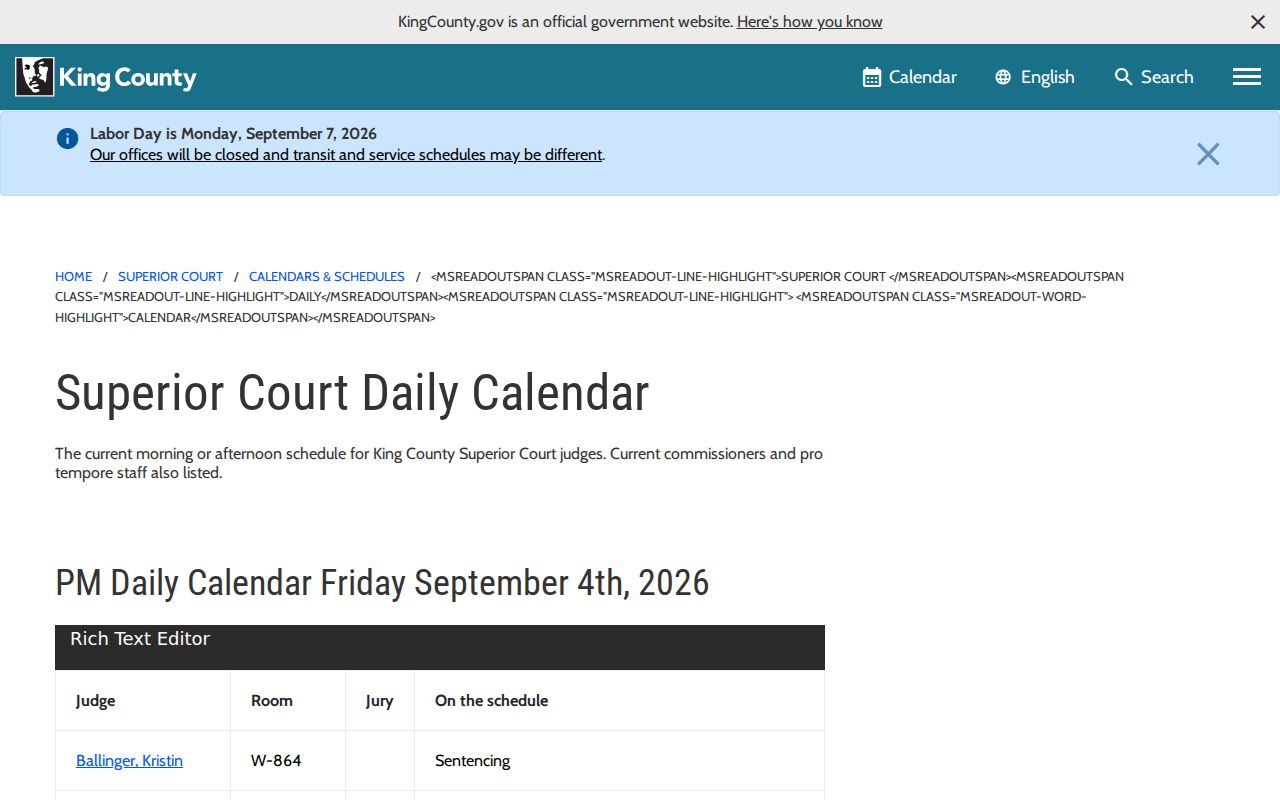
That link follows the official calendar route for Superior Court. Use it once you have confirmed the matter belongs to Superior Court and that the date and assignment match the case record.
Finding Your Court Date
Begin with the notice. It controls everything: the court name, case number, date, location, and any remote appearance details. When you search, use the case number rather than a name, because the number points to one file and skips the confusion that comes from people with similar names.
- Read the newest hearing notice and identify Superior, District, or municipal court.
- For Superior Court, sign in to KC Script and check the case calendar or docket, then compare the correct published calendar.
- For KCDC, sign in, search the case, and separate future events from entries marked Held or otherwise completed.
- For a municipal or District Court date, also try AOC Find My Court Date; it cannot search Seattle Municipal Court.
- If no reliable result appears, call the court or visit the clerk counter or public terminal. Check any daily printed or posted calendar at the court.
- Confirm on the morning of the proceeding, especially after a closure, reset, holiday, or portal outage.
Need a voice on the phone? Call Superior Clerk at 206-296-9300 or KCDC at 206-205-9200. For city matters, Seattle Municipal is 206-684-5600, Kent is 253-856-5730, Renton is 425-430-6550, and Federal Way is 253-835-3000. A party's attorney may also hold the newest court notice.
KCDC Events Show Court Dates
The KCDC portal needs free registration and a login before it will open a case. Search by exact case number when you can. A person search forces a choice between Criminal/Infraction and Civil, plus a filing date range and name fields. Civil searches accept a company name. Search windows can span up to 365 days at once.
Once you find the case, open the blue case number and read the Summary plus the future-hearing panel. The Events tab holds the full history, past and future. Each entry shows the event date, time, type, result, official, location, and a Minute Record. An entry marked "Held" has already happened. Compare any future event against the latest notice before you plan around it.
The KCDC case-access help is the portal's official aid. If your case does not appear, widen the filing window, confirm the court and location, try the statewide index, or call the clerk.
How to Read a Court Setting
A King County court date line bundles several facts together, so read them as a set. Each piece matters. The right date at the wrong courthouse is not a usable setting, and a calendar category without a case-specific entry is not proof of a scheduled hearing.
| Date | The scheduled calendar day; use the newest active entry. |
|---|---|
| Time | The listed start or calendar-call time, which may not be an individual hearing start. |
| Courtroom | The room, building, location code, or approved remote appearance information. |
| Judge | The judicial officer or assigned department, subject to calendar reassignment. |
| Setting type | Arraignment, motion, omnibus, plea, trial, sentencing, status, probate, family, or another calendar activity. |
| Result | Held, continued, reset, vacated, or another status showing what happened to a past event. |
Never read a trial setting as proof that trial began. A plea calendar does not establish that a plea was entered either. The event result and the signed record show what actually occurred in court.
King County Criminal Calendar Timing
Superior Court posts Seattle and Kent criminal calendar files. They go up by 3 p.m. for the next court day. Seattle groups its calendar into Bond, Competency, Criminal Motions, Expedited Motions, and Omnibus. Plea, Trial, and Friday Sentencing round out that list. Kent runs the same named core groups, without a separately listed Competency calendar.
The labels explain why a case shows up on a given list. An omnibus setting is a pretrial case-management event. A bond calendar deals with custody or release terms. Friday Sentencing marks a sentencing setting. A trial calendar is an assignment list only, not proof that evidence was heard.
Check the official criminal calendar page close to the hearing date. Even a next-day posting can still be changed by court order.
Continuances, Resets, and Cancellations
Dockets can lag. An old King County court date may still sit on the case even after a new setting takes its place, so scan the Events tab for a reset, a continuance entry, and the replacement date before trusting anything. The wording tells you what happened. "Vacated" means the event came off the schedule. "Held" means it went forward. And a continuance only moves the proceeding. It does not dismiss the case.
Verify in order: your notice first, then the local portal, then the docket or Events view, then the published daily calendar, and finally the clerk or court coordinator. KCDC warns that its listed times shift and need court approval. Superior Court's next-day file is no substitute for direct case notice either. When an online calendar drops a case, treat it as unconfirmed until the court itself says so. Note: Keep every new notice, because a stale docket event can stay visible after the active King County court date has changed.
KCDC Calendar Availability Is Different
The King County District Court also posts a Courtroom Calendar Schedule for anyone planning criminal dates ahead. You can filter by Courtroom, Hearing Type, Jurisdiction, and Judge, hide sessions that are full, and hit Load Calendar. It answers one question only. The tool shows which sessions have room. It cannot pull up the date already tied to your case. So it is not a docket lookup at all.
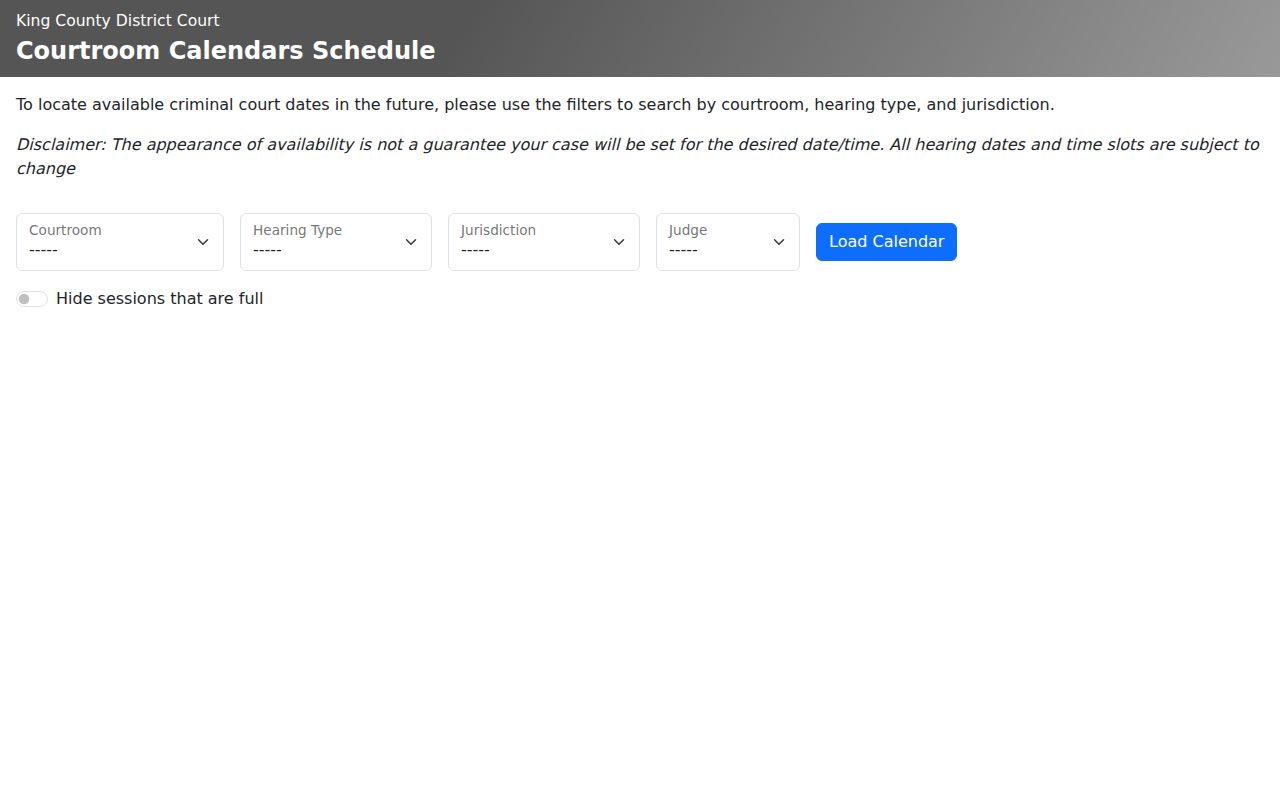
That is why this calendar is easy to mistake for the Summary and Events tabs. It is not. Availability is purely informational, every slot still requires court approval, and landing in an open session does not place a case on the King County court calendar. Use the docket for that.
King County Setting Terms
Terms on the King County calendar describe work the court plans to do. Treat them as schedule labels only, not results, until the docket itself shows one.
- Arraignment
- A first formal appearance addressing charges, rights, plea, or the next step.
- Omnibus
- A pretrial case-management setting used to review discovery, readiness, plea, and trial posture.
- Status or review
- A check on compliance, custody, treatment, probation, protection orders, or case progress.
- Civil trial assignment
- A Superior civil calendar showing assignment or standby status.
- Ex parte
- A short or emergency submission handled through Superior Court's ex parte and probate process.
- Docket call
- A call of cases to assess readiness and next scheduling steps.
Family-law motions, probate, civil protection orders, and municipal hearings each run on their own schedule rules. Follow the notice you received. Definitions do not transfer from one King County calendar to another.
If You Miss a Court Setting
Move fast. Pull up the docket and look for a result, call the assigned court, and reach your lawyer if you have one. Ask what the court record now shows and what formal step comes next. Clerk staff can point you to the right case number and current calendar information, but they cannot give legal advice or promise you a new hearing.
Missed a setting? A missed criminal, infraction, or other required appearance can lead to a failure-to-appear entry, warrant, adverse ruling, or other court action.
Call the court of record and counsel promptly, then follow the court's instructions for any motion, response, payment, or new appearance.
Do not appear at a guessed time or assume an online availability slot has reset the case.
Miss a traffic or infraction setting and the stakes compound. No response can mean a finding and added penalties. It can also bring collection action and a referral to the Department of Licensing. The case docket and the clerk hold the current status. Check both.