
How to Search Cases by Name
Know the court level first, then search by name. The Washington AOC Person Search covers participating courts, but King County's local portals reach deeper into their own dockets. A common name returns many rows. Compare court, case type, filing year, and caption before you open anything. King County District Court needs a Criminal/Infraction or Civil case type, a filing period, and first and last names for a person search. Date of birth stays optional. The portal caps each search window at 365 days. Civil searches accept a company name instead.
- Identify Superior, District, or the municipal court from the notice.
- Open that court's official portal and select the matching case type.
- Enter the name as it appears on filed papers and narrow the filing period.
- Compare case number, court, caption, and status before opening a record.
- Call the court or use a public terminal when no sound match appears.
| King County field | Type | Required | Use |
|---|---|---|---|
| First and last name | Text | Yes | Use the spelling on filed papers |
| Case type | Choice | Yes in KCDC | Criminal/Infraction or Civil |
| Filing date | Date range | Yes in KCDC | No more than 365 days at once |
| Date of birth | Date | No | Separates similar names |
| Company name | Text | Alternative | For a KCDC civil search |
King County Case Lookup by Court
No single King County case database exists. The KC Script Portal handles Superior Court matters: felony, major civil, family, probate, guardianship, and protection-order cases. District Court keeps its own limited civil, small-claims, infraction, misdemeanor, and preliminary felony records. They sit in a separate e-Filing and Case Access Portal. Municipal court choice matters too. Seattle runs its own public portal. Kent, Renton, and Federal Way publish separate routes. Bellevue's municipal service runs through King County District Court. Read the court name on your ticket, notice, or pleading first; it saves real time.
King County Seattle Case Search
Seattle Municipal Court keeps a public portal for city misdemeanor, infraction, parking, and traffic matters. It shares nothing with the KC Script or KCDC detail view. Search the Seattle system first. Do that whenever the notice names Seattle Municipal Court. Go to its Records Unit for older criminal and non-criminal material. Civil matters belong with the civil clerk, not the portal. Statewide tools only go so far. AOC may return an index entry for Seattle. Find My Court Date excludes that municipal court entirely. So a missing statewide date result should send you back to Seattle's portal or clerk. It does not mean no hearing exists.
How to Search by Case Number
A case number beats a name search because it points to one court file. King County has no universal format across Superior, District, and city courts. Copy the number from your notice exactly. In KCDC, strip spaces before or after the number. Pick Case Number, then follow the blue result link. A Superior civil number might look like 25-2-12345-1 SEA. Never rebuild a number from that example. And never assume another court shares the pattern. KC Script now requires a free account. The Clerk made that change for public case search on June 19, 2026. Search by number, then dig into the case index, docket, calendar, orders, judgments, minute entries, and documents. Remember: the number opens the file, but it does not unlock confidential content.
King County Case Search Windows
The KCDC filing-date window causes many false "not found" results. Split any broad name search into periods of 365 days or less. Try an older or newer span before deciding King County District Court has no case. Check the case type too. Filings are either civil or Criminal/Infraction. The official KCDC case-access help notes some cases never appear online. Public terminals work. Staff will route a request, though they cannot do legal research. The central clerk line at 206-205-9200 is a practical fallback. A name-search miss can mean several things. The wrong court, the wrong date window, a spelling slip, or an access limit. It does not always mean the case is absent.
King County Case Number Differences
Superior, District, and municipal systems each number cases their own way in King County. A Superior civil number can carry several parts. There may be a filing year, a case-type digit, and a sequence. It can also include a check digit and an assignment suffix like SEA or KNT. KCDC and the city courts use separate identifiers. Keep every digit, dash, and suffix just as the latest court paper shows it. If a number fails, confirm the court before touching the format. Never drop a valid suffix. Forcing a city citation into a Superior pattern hurts too. Either mistake can aim your case lookup at the wrong database. The clerk named on the notice can verify the right identifier.
What a Case Search Shows
A King County case detail view maps the activity, not always the documents. KCDC splits things into Summary, Charges, Documents, Events, Other Cases, and Register of Actions. Under Events you may find plenty. A hearing date, time, type, result, judicial officer, location, and minute record can all appear there. Images can require an attorney or government account. A case-party token works too.
| Case number | The court's unique file identifier. |
|---|---|
| Caption | The named parties and roles. |
| Filing date and status | When the matter began and whether it is open or closed. |
| Events | Past and future settings, results, officer, and room. |
| Register of Actions | A dated chronology of docket activity. |
| Documents | An index and, when access permits, a filed image. |
The AOC Case Records Search warns that docket, judgment, links, and status may lag or stay incomplete. Updates land about a day after clerks enter data. Verify any key event with the local clerk and the filed order.
King County Case Search Login
Forget the old advice that King County Superior Court docket searching works without a login. Since June 2026, it doesn't. The King County Clerk's instructions now tell anyone to create a free account. Sign in first.
Know what the portal shows. A docket entry is not the same as a filed document. A case lookup may confirm an order exists. The image stays locked. You can request the document, or ask for a fee waiver if you qualify. Stop by a records-access public area.
The statewide source displays the official AOC search screen.
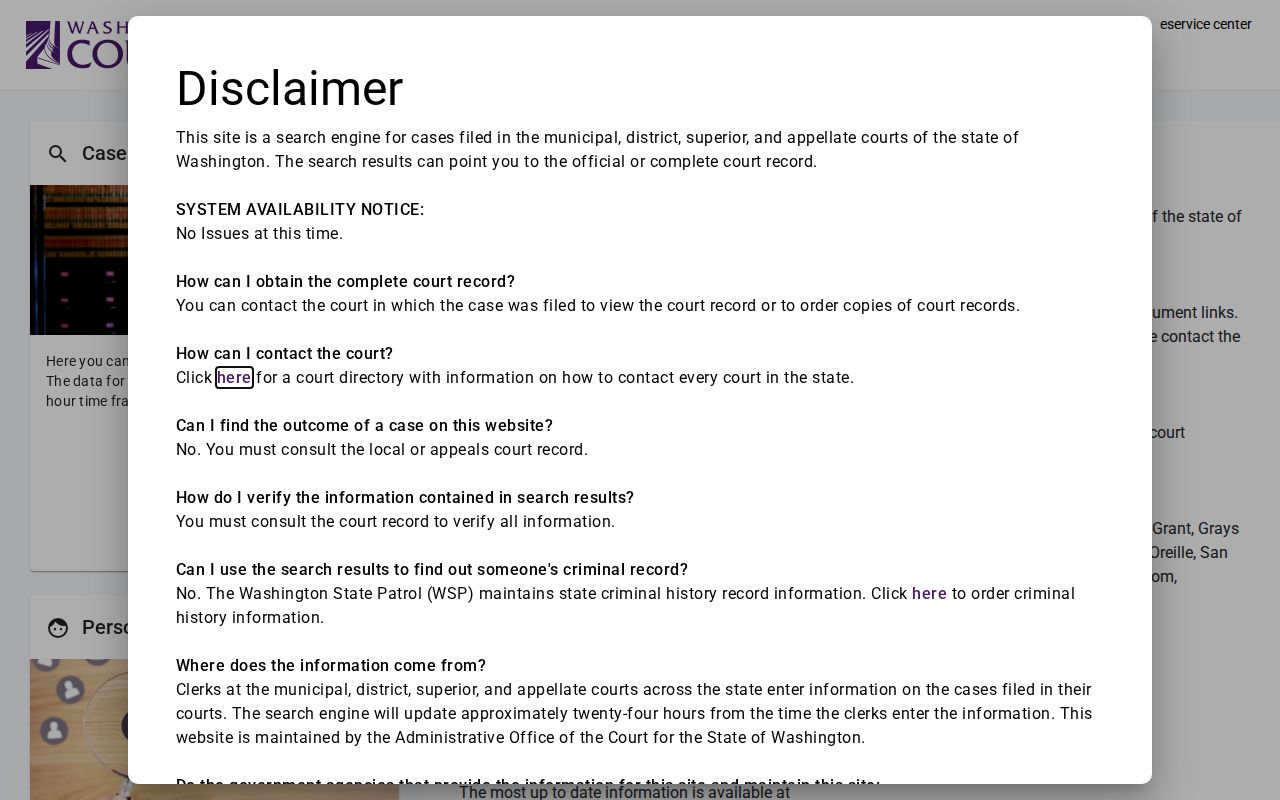
Treat that screen as a statewide starting point, never as a stand-in for the King County court of record.
King County Case Result Tabs
Each tab on a case result answers a different question about the King County docket. The KCDC Summary view lists the caption, filing date, case status, and any future hearing. Charges shows the allegations actually filed, where that applies. Events carries the wider hearing history. Register of Actions lines up the dated sequence of court activity. Documents can name an item even when the image is closed to your account.
Pick the tab that fits the question. Events works for checking a setting. Register of Actions traces the filing sequence. Documents pinpoints a specific order or pleading. For an official copy, go to the responsible clerk.
County vs Statewide Case Search
Statewide tools are broad finding aids. Local King County systems run deeper and sit closer to the official court file. Use both when you're unsure which court holds the case, then let the local record take priority once you've found it.
| Route | Coverage | Best use |
|---|---|---|
| AOC Case Search | Participating courts | Finding a court or level |
| Find My Court Date | Many courts, not Seattle Municipal | Finding a listed hearing |
| KC Script | King County Superior | Local docket and documents |
| KCDC portal | District Court and Bellevue | Summary, Events, actions |
| City route | One municipal court | Seattle, Kent, Renton, or Federal Way |
JIS-Link is a paid subscription, not the fee-free AOC index. And the current Odyssey deployment does not replace King County courts.
Missing King County Case Search Results
Run through the basics before assuming a King County case lookup failed. Check the court name, case type, spelling, filing period, and number. Then try the local portal and the AOC index. Superior Court help is at 206-296-9300 or a Clerk terminal. For KCDC, call 206-205-9200 or visit a court location. Municipal matters belong with that city clerk.
Timing explains some gaps. A fresh filing may not have reached every index yet. The AOC warns its data can lag. It can trail clerk entry by about 24 hours. The AOC also treats results as an index, not the official record. Older KCDC matters can fall outside the first 365-day search window. Widen the filing period, then use the court's counter if the online result stays blank. If a portal seems down, help is close. The Clerk's alerts or the local court office can confirm an outage.
KCDC takes a Request for Court Records by email at kcdc.webmaster@kingcounty.gov. Superior Court requests can go by mail on the Clerk's form. Sealed documents cannot be requested that way. Name the case, party, specific record, and known date. A request for one named order, judgment, or docket entry routes more easily. A demand for "all information" does not. The King County court record search covers copy products.
King County Case Search at Terminals
Public terminals are the fallback. Use them when a portal skips an older matter or you can't reach the needed view. KCDC says every District Court courthouse has public computers with clerk help nearby. The Superior Court Clerk runs three records-access public areas. Most public documents can be viewed there without a copy charge.
A terminal changes nothing about access law. Sealed, confidential, juvenile, adoption, and protected family material stays restricted. Bring the case number and current identification when access turns on party status. Call ahead for an archived file.
Restricted Cases and Access Rules
Washington GR 31 begins with public access. But it accepts limits. Law, rule, court order, and case law can all set them. Juvenile offender information can never appear on a public website. GR 22 adds further controls for family, guardianship, health, and therapeutic-court material.
Some King County records stay hidden or restricted. These include sealed, juvenile, adoption, paternity, dependency, mental-health, and confidential name-change files. The Clerk may ask for identification and run a virtual identity check. Certain confidential cases cannot even be confirmed. So a failed public name search never proves that no matter exists.
Access limit: Washington GR 15 governs sealing and redaction. Request access from the court that holds the file and be ready to prove identity and authority.