
Searching the King County Court Docket
Look first at whatever paper started your search. It may be a citation, a notice, or something filed with the court. The court named there tells you where the King County court docket lives. KC Script belongs to the King County Superior Court Clerk. It covers Superior Court cases and documents. For King County District Court, use the District Court e-Filing and Case Access Portal, which handles civil, small-claims, protection-order, impound, criminal, and infraction cases. City matters may sit elsewhere. Seattle, Kent, Renton, and Federal Way each run their own Municipal Court. Bellevue's municipal service runs through District Court.
A full case number opens doors. So do a party name, the court level, the case type, and a likely filing year. Not sure which local court holds the record? The free Washington Courts Case Records Search gives you a statewide index. Just know its entries can lag, and they are not the official complete record.
- Read the court name and case number on the newest notice.
- Choose KC Script, the KCDC portal, or the proper municipal court route.
- Search by the exact number, or use the party name with court and case-type filters.
- Open the case summary and review Events or the register of actions.
- Confirm a setting with the responsible clerk and order certified copies there.
King County Docket Portal Paths
There is no single King County docket database. Access splits by jurisdiction instead. KC Script asks for a free account and login before case search, per its June 19, 2026 requirement, and it also handles document requests, a cart, payment, fee-waiver requests, and sealed-case workflows. KCDC also wants a free account for case lookup, though ticket payment works without one. Its public portal splits Criminal/Infraction and Civil into separate searches.
A third route is the statewide AOC index. Pick District and Municipal, Superior, or Appellate Courts, then search by name, business name, or case number. It returns a summary, calendar data, and case activity. It cannot replace the clerk. Seattle Municipal Court runs its own portal, and the statewide Find My Court Date tool leaves Seattle out on purpose.
| Route | Best Use | Key Limit |
|---|---|---|
| KC Script | Superior Court cases and document orders | Free login required for search |
| KCDC Portal | District Court cases, events, and document index | Images depend on role or party token |
| AOC Search | Finding the court of record statewide | May be delayed or incomplete |
Inside a King County Court Docket
Think of a King County court docket as two parts. A header names the case, the court, the filing date, the caption, and the current status. Below it runs a dated trail of pleadings, motions, orders, hearings, and results. KCDC organizes things with exact labels: Summary, Charges, Events, Documents, Other Cases, and Register of Actions. A finished item may read Held. The next active event shows its time, judicial officer, and location.
The docket is not the whole case file. A Documents tab can list a filing even when the image stays closed to public view. Protected identifiers get suppressed. And a certified copy is a clerk-authenticated product. A search result can never stand in for one.
| Case Number | The court-specific identifier; King County systems do not share one universal format. |
|---|---|
| Caption and Parties | The formal case name and each party's role. |
| Register of Actions | The dated list of filings, court acts, and case events. |
| Events | Past and future hearings with type, result, official, and location. |
| Status | Current open, closed, disposed, or restricted state. |
| Documents | An index of filed material; image access can be limited. |
King County Docket Labels Decoded
Labels separate a filed act from a hearing. An Events entry might be a future setting, a past setting, or a result. So read the label before assuming anything. The Register of Actions is the running chronology. A Minute Record tells you what happened at a proceeding. A notice of setting says when and where a future hearing should occur. Always work from the newest entries rather than trusting one old date.
- Arraignment
- The first formal criminal appearance, when charges and rights are addressed.
- Omnibus
- A pretrial case-management setting used to check discovery, readiness, plea, and trial posture.
- Continuance or Reset
- A move from one scheduled date to a later date.
- Disposition
- The case outcome, such as dismissal, conviction, acquittal, judgment, or deferred finding.
- Minute Record
- A short event-linked record of what took place in court.
Room codes carry weight too. KCDC uses MHC, MHE, MHS, and GB for particular mental-health and community-court locations. Each code points to an actual room or building, not just a case category.
Courts That Keep Dockets in King County
Which clerk keeps a King County court docket depends on jurisdiction. Superior Court takes felonies, major civil suits, family, probate, guardianship, juvenile, and other general-jurisdiction work. District Court handles misdemeanors and traffic and non-traffic infractions. It also covers small claims, limited civil cases, protection orders, name changes, and preliminary felony matters. Municipal courts keep city ordinance, misdemeanor, parking, and infraction dockets within their own authority.
| Court | Docket Covers | Where to Search |
|---|---|---|
| King County Superior Court | Felony, major civil, family, probate, juvenile | KC Script and Superior Court Clerk/DJA |
| King County District Court | Misdemeanor, infraction, small claim, limited civil | KCDC portal, clerk, or public terminal |
| Municipal Courts | City misdemeanors, ordinances, traffic, parking | City portal or clerk, plus AOC index where covered |
| Washington Court of Appeals | Appeals from trial-court decisions | AOC appellate search and Division One |
A city name does not settle the question. Bellevue and Beaux Arts municipal services run through KCDC, and a Seattle case may land in Seattle Municipal Court, District Court, or Superior Court, all depending on the charge or claim.
King County Docket Clerk Split
Recordkeeping splits along the same lines. The King County Superior Court Clerk's Office, also called the Department of Judicial Administration, maintains Superior Court records. District Court clerks keep the KCDC files. Every independent municipal court keeps its own city records. This split is why a name search can return nothing even when a case exists; the search may simply target the wrong court or portal.
When a portal fails, follow the access chain for that office. KCDC offers public computer terminals at every District Court courthouse, a records-request form by email, and phone help. Superior Court provides three public records-access areas where most public documents can be viewed free. Municipal records come from the city court clerk. The official Washington court directory helps confirm contact details.
Portal miss: Check the court level, case type, filing window, spelling, and case number. Then ask the court of record to confirm the file.
How to Find Court Dates and Settings
For a case's next setting, the newest docket event is your best online source. KCDC lists future hearings in the Summary panel. All past and future hearings sit under Events. On the Superior Court side, KC Script and the Superior Court calendar pages do the same work. The county posts daily calendars plus separate Seattle and Kent criminal calendars. Those criminal calendars go up by 3 p.m. for the next court day.
The King County court dates page walks through every calendar channel. Start with the filed notice. Compare it to the newest active event, then check the correct daily calendar. If anything conflicts, call the court or clerk. One caution: the KCDC Courtroom Calendar Schedule only shows possible future criminal-date availability. It does not prove a case has been set. Every slot still needs court approval.
Setting flow: Notice › case Summary › Events › daily calendar › clerk confirmation.
King County Seattle-Kent Docket Calendars
King County Superior Court splits its public calendars by workload and by courthouse. Criminal matters in Seattle and Kent run through Bond, Criminal Motions, Expedited Motions, Omnibus, Plea, Trial, and Friday Sentencing calendars. Seattle adds a Competency calendar on top of those. Civil work gets its own routes. Those include trial assignments, standby, chief civil, ex parte and probate, family-law motions, and protection orders.
Reading a King County court docket takes some care. A case listed on a Trial calendar was placed there. That placement alone does not prove trial began. Resets can leave a stale date sitting in the entry. So look for a fresh active event plus a result like Continued, Vacated, Reset, or Held. Notices from the court still control everything. Settings can shift after a ruling, a closure, a holiday, or a courthouse outage.
District Court also runs Saturday and holiday jail calendars. Where the hearing sits matters as much as when. Some Seattle calendars are heard at the correctional facility rather than a standard courtroom.
Public Access to Court Dockets
Most King County court records are open, though the openness has edges. Court rules govern the record system itself in Washington. Administrative judiciary records answer to a separate rule. The Washington Public Records Act can reach agency and municipal administrative material. Yet it cannot replace the court-record request process. Keep one quirk in mind. A docket entry may be public even when its filed image is withheld or redacted.
Key Rules:
Washington GR 31 opens court records unless law, rule, order, or case law restricts them.
Washington GR 15 governs sealing, redaction, and destruction, with targeted redaction generally preferred.
Washington GR 31.1 provides a distinct process for judicial administrative records.
RCW 42.56.070 governs public inspection and copying of agency records, subject to exemptions.
Some categories carry added controls. Juvenile, adoption, paternity, mental-health, dependency, confidential name-change, family-law, guardianship, protection-order, and therapeutic-court material can all be restricted. Getting in may require identification, proof of authority, or a court order.
Restricted King County Docket Results
A confidential case may never surface in a public King County docket search. The Superior Court Clerk may not even confirm that certain adoption or expunged juvenile matters exist. An authorized person may have the case number. The clerk can still ask for current government identification plus a separate request. KC Script supports a virtual identity check. Sealed documents will not simply be mailed to someone lacking the required authority.
KCDC goes further on its public portal. It suppresses addresses, phone numbers, birth dates, and other personal identifiers. That suppression does not seal the case. One public document may show protected details blacked out. Another document in the same case stays withheld. Juvenile web display faces special restriction under GR 31 and RCW 13.50.100. When a search comes up empty, the honest reading is that access may be restricted or the search incomplete. That does not mean no case exists.
Docket Records at the Clerk's Office
The Superior Court Clerk/DJA holds the county's general-jurisdiction case files. At the clerk's records-access areas, the public can view most open documents free of charge. Copies, plain or certified, can be ordered there. Audio and similar items go through their own channels. KC Script orders and finished recordings sit in the portal or ShareFile for only a limited download window. Save completed files promptly.
The downtown counter sits inside the King County Courthouse. South county has a second major route at the Maleng Regional Justice Center in Kent. Expect court security screening at either one. A file may be old, archived, sealed, or held by a different court. Calling ahead helps.
King County Courthouse Record Access
King County dedicated its present courthouse in 1916. The Beaux-Arts design used regional stone, bronze, marble, and clay. For a record searcher, though, the value is practical. Public counters, courtrooms, and access terminals all sit under one roof. Note that the clerk's customer-service stations close midday. The office otherwise keeps regular weekday hours. Security screening applies, and nearby parking is paid.
The official Department of Judicial Administration page posts the clerk's current services and alerts. That makes it the natural public starting point for a King County court docket request.
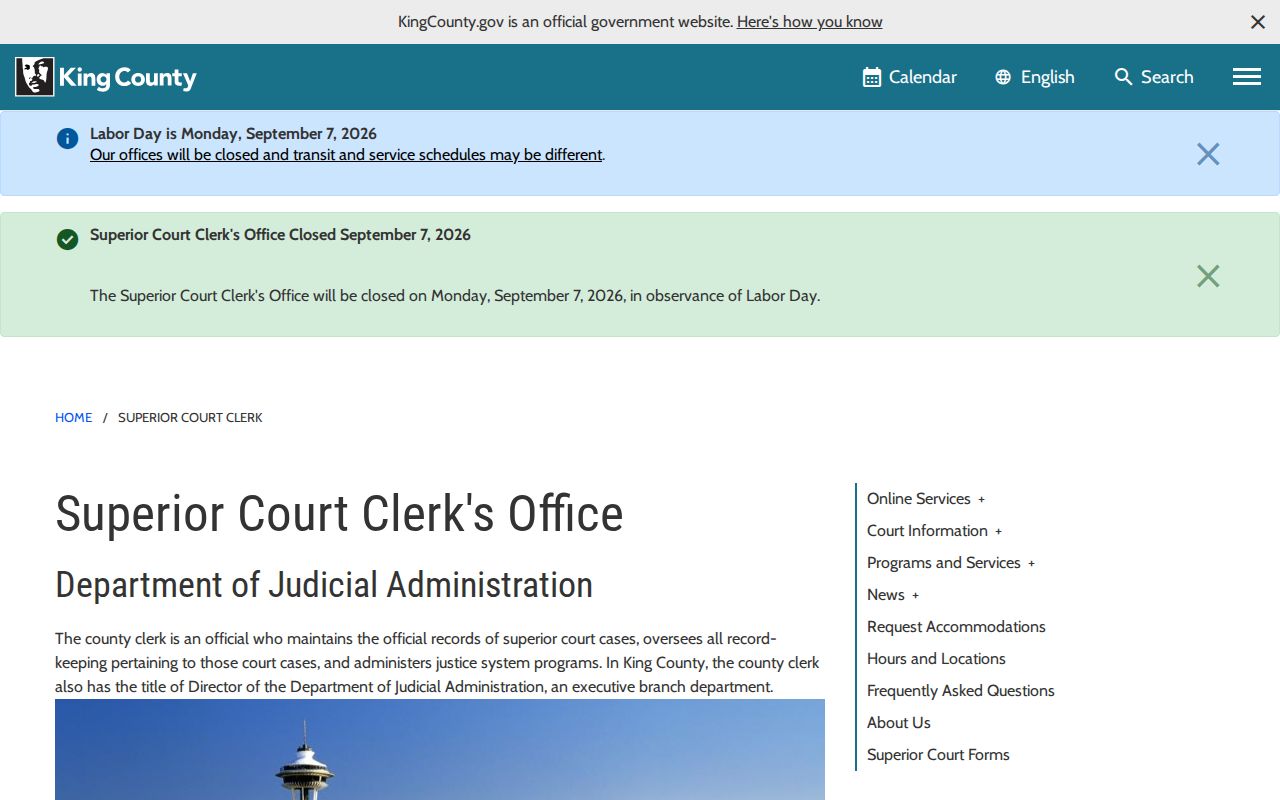
Turn to the clerk page for current service notices, records access, fees, and KC Script instructions. A trip to the courthouse never bypasses a sealing rule or any other limit.
King County District Court Docket Access
KCDC runs ten locations across East, South, and West divisions. Its civil filing areas can cross those lines. A case tied to one city may be filed or heard somewhere else entirely. Trust the location named in the portal and on your notice. Vashon breaks the pattern in a unique way. Its District Court location is operated with Burien and opens just one day each month.
The King County District Court website links the case portal, location list, records help, calendars, forms, and citation routes. Through the public portal you can see hearing dates, judgment information, conditions of sentence, warrant status, protection-order status, and a document index. Every courthouse also keeps public terminals. They are a solid fallback for anyone who cannot work the online system.
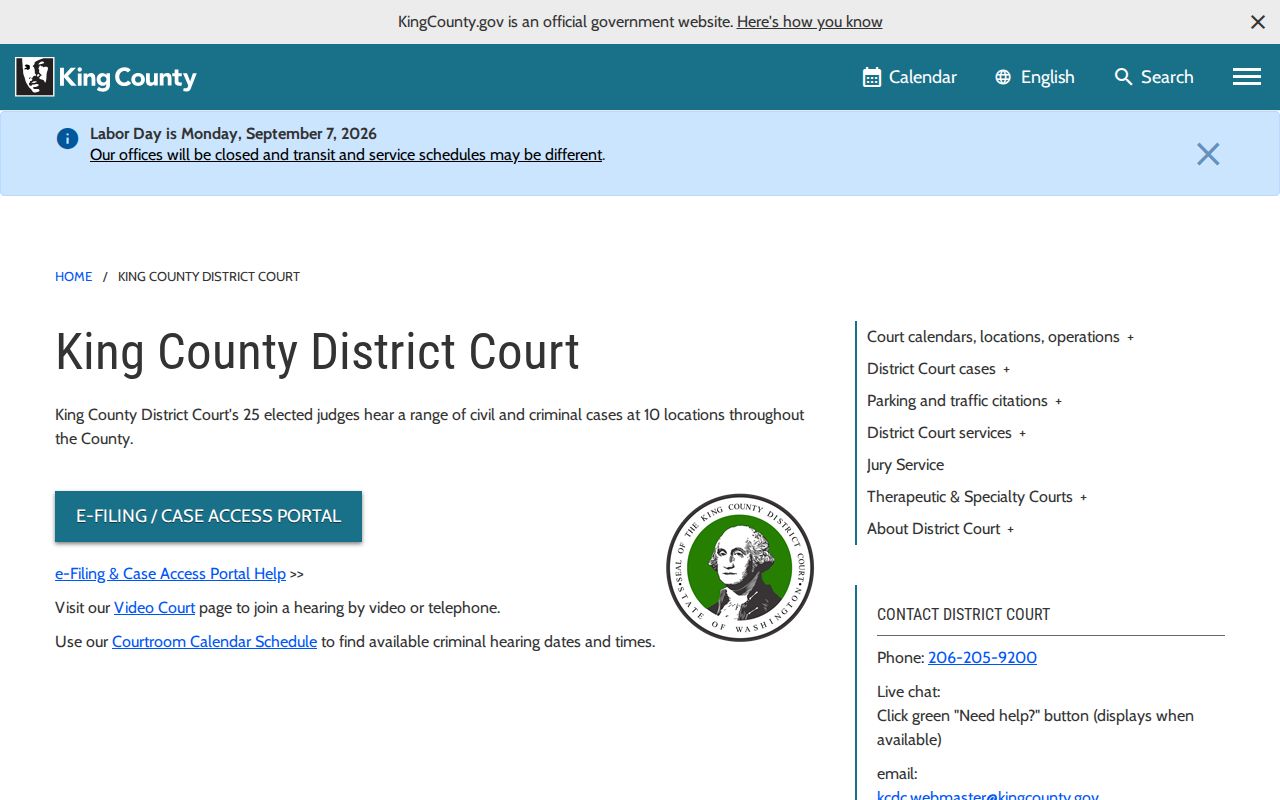
The District Court page states it plainly. KCDC is its own custodian, distinct from the Superior Court Clerk and from the city clerks.
King County Court Dockets by City
King County Court Dockets by City
Big cities in King County split their court dockets down different paths. In the 2025 Washington Office of Financial Management population ranking, five stand out. Seattle runs its own municipal court, and so do Kent, Renton, and Federal Way. Bellevue is the odd one out. That city gets its municipal service through King County District Court. It has no city bench of its own.
What belongs where is mostly a matter of severity. City dockets cover municipal-code offenses, traffic and parking matters, and lower-level criminal cases. Anything bigger goes to the county's Superior Court docket instead. That means felonies, major civil disputes, probate, or family law. Each city card below lays out the local route for court dates, tickets, and case records. Population rank explains why these five cities are featured, nothing more. It says nothing about how busy each court docket actually is.
Seattle Docket Search
Independent municipal portal, calendars, Records Unit, and civil clerk.
Bellevue Docket Search
Municipal services and records run through KCDC's Bellevue facility.
Kent Docket Search
City court plus separate county courts at the nearby MRJC.
Renton Docket Search
City Hall court with its own date and records-request routes.
Federal Way Docket Search
City date database and direct court-administrator records route.
Map and Directions to the King County Courthouse
Downtown Superior Court, King County District Court, and Seattle Municipal Court share the King County Courthouse at 516 Third Avenue in Seattle, where the Superior Court Clerk's records-access areas offer free viewing of most public documents during business hours. South King County's Superior and District Court docket is instead heard at the Maleng Regional Justice Center in Kent, where Superior Court mail uses Room 2D and District Court's office is Room 1A. Which building holds a given file depends on where the case was filed or is heard, so confirm the location on the hearing notice or case portal before choosing a courthouse.
King County Courthouse
516 Third Avenue
Seattle, WA 98104
206-296-9300
Monday through Friday, 8:30 a.m. to 4:30 p.m.; customer-service stations close 12:15 to 1:15 p.m.
Maleng Regional Justice Center
401 Fourth Avenue North
Kent, WA 98032
206-296-9300
Monday through Friday, 8:30 a.m. to 4:30 p.m.
Both buildings require security screening at entry. Parking at the Seattle courthouse is paid in nearby garages and lots, while the MRJC's free garage often fills by 8:30 a.m., with overflow parking at the accesso ShoWare Center; MRJC also offers accessible parking on garage levels one and two, wheelchair lifts at courtroom benches, and accessible witness and jury boxes. The Clerk's Office remains open on non-judicial days even when courtrooms are closed.